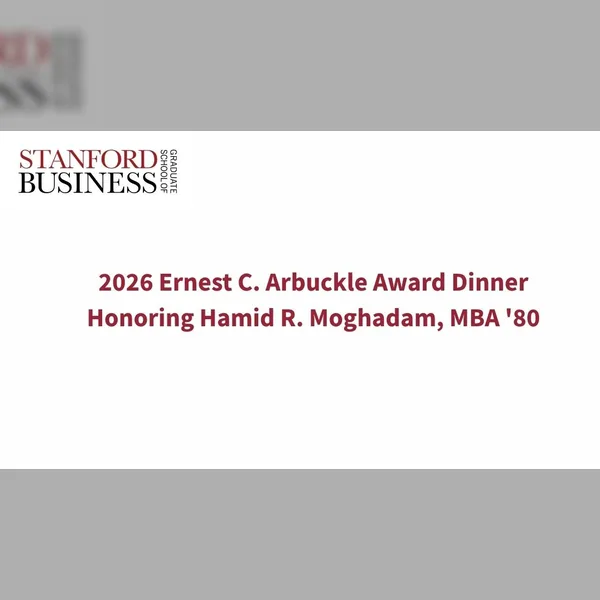
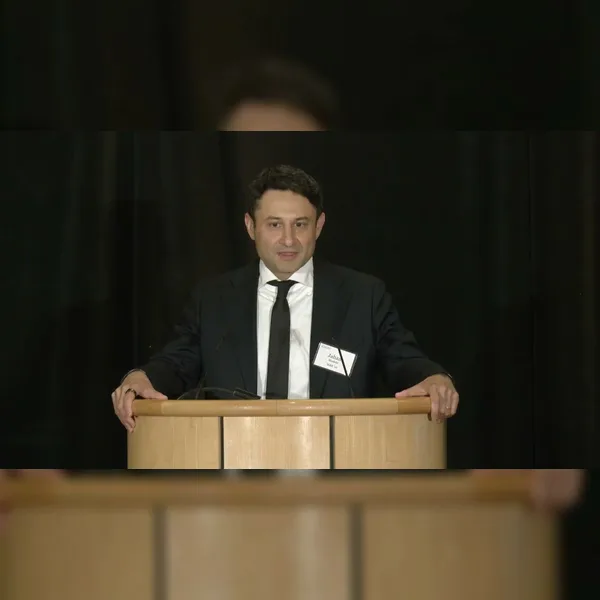
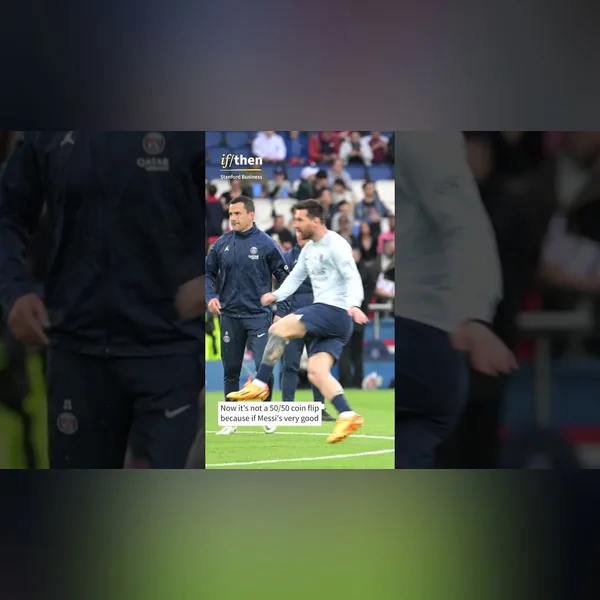
Stanford Graduate School of Business honored Hamid Moghadam , MBA ’80, Co-Founder and Executive Chairman at Prologis, with the 2026 Ernest C. Arbuckle Award. A program to honor Hamid took place at the Frances C. Arrillaga Alumni Center on May 12, 2026.
11:48
Stanford Graduate School of Business honored Hamid Moghadam , MBA ’80, Co-Founder and Executive Chairman at Prologis, with the 2026 Ernest C. Arbuckle Award. A program to honor Hamid took place at the Frances C. Arrillaga Alumni Center on May 12, 2026.
We are living through a generational shift in technology, in geopolitics, and in the nature of work itself. The leaders who will matter most are the ones who understand that their choices have real consequences and who are willing to be accountable to them.
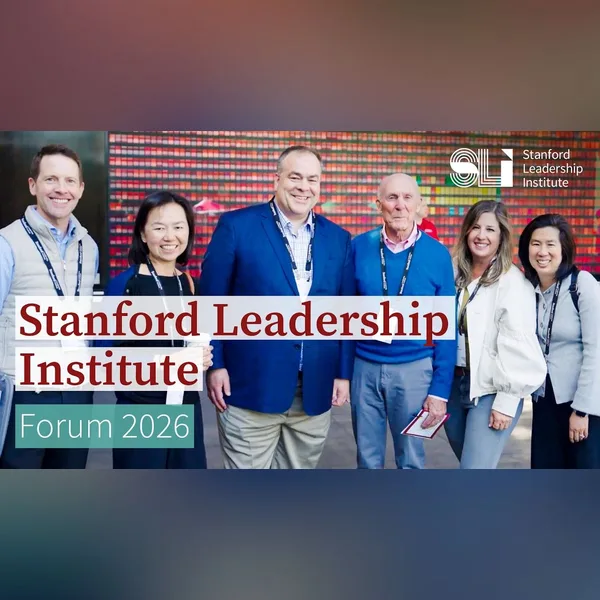
The Stanford Leadership Institute (SLI) at Stanford Graduate School of Business brings together leaders from government, industry, and academia to address the critical challenges of our time and to prepare the next generation of leaders to navigate them.
Watch the full session playlist here: https://youtube.com/playlist?list=PLxq_lXOUlvQAoyTSbcDK-G6UkT1mAdc1y&si=s7wh00K9YPhoYUJu
Learn more about the Stanford Leadership Institute here: https://stanford.io/4vnrLV7
2:22
We are living through a generational shift in technology, in geopolitics, and in the nature of work itself. The leaders who will matter most are the ones who understand that their choices have real consequences and who are willing to be accountable to them.
The Stanford Leadership Institute (SLI) at Stanford Graduate School of Business brings together leaders from government, industry, and academia to address the critical challenges of our time and to prepare the next generation of leaders to navigate them.
Watch the full session playlist here: https://youtube.com/playlist?list=PLxq_lXOUlvQAoyTSbcDK-G6UkT1mAdc1y&si=s7wh00K9YPhoYUJu
Learn more about the Stanford Leadership Institute here: https://stanford.io/4vnrLV7
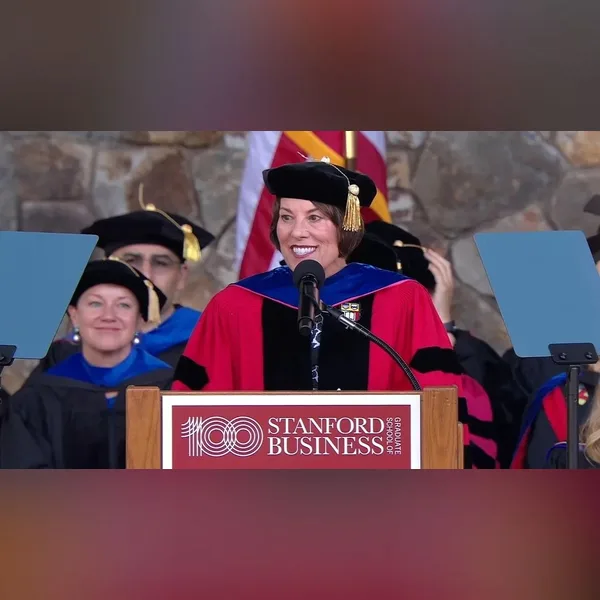
Dean Sarah A. Soule reflects on what it means to lead — to reach ahead while carrying forward the legacy of what came before. “Great ideas, and great leaders, are not formed all at once,” she tells the Class of 2026. “They are built over time, piece by piece, like a mosaic.”
1:34
Dean Sarah A. Soule reflects on what it means to lead — to reach ahead while carrying forward the legacy of what came before. “Great ideas, and great leaders, are not formed all at once,” she tells the Class of 2026. “They are built over time, piece by piece, like a mosaic.”
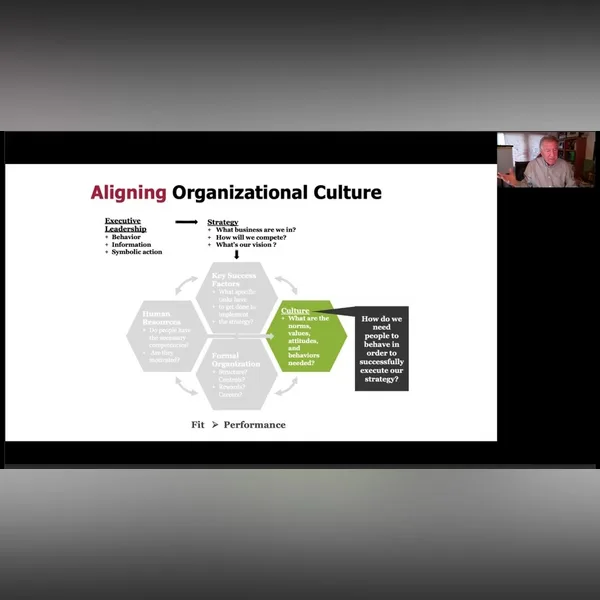
Leaders remain skeptical about the power of organizational culture, despite extensive research demonstrating its crucial role in business success. In this GSBooks session, Glenn R. Carroll, the Adams Distinguished Professor of Management, provides key insights from his book, "Making Organizational Culture Great," and challenges common misconceptions about the importance of organizational culture. Professor Carroll also addresses a variety of audience questions ranging from how rapidly organizational culture can be changed to the impact of organizational homogeneity on decision-making.
Recorded on June 18, 2026.
1:00:18
Leaders remain skeptical about the power of organizational culture, despite extensive research demonstrating its crucial role in business success. In this GSBooks session, Glenn R. Carroll, the Adams Distinguished Professor of Management, provides key insights from his book, "Making Organizational Culture Great," and challenges common misconceptions about the importance of organizational culture. Professor Carroll also addresses a variety of audience questions ranging from how rapidly organizational culture can be changed to the impact of organizational homogeneity on decision-making.
Recorded on June 18, 2026.
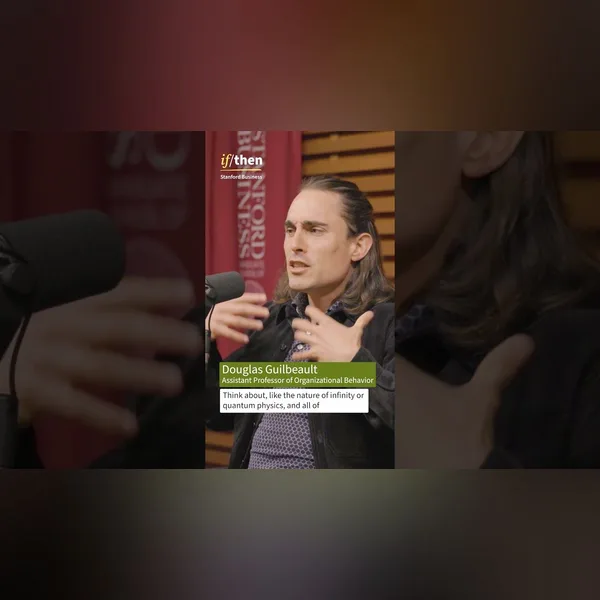
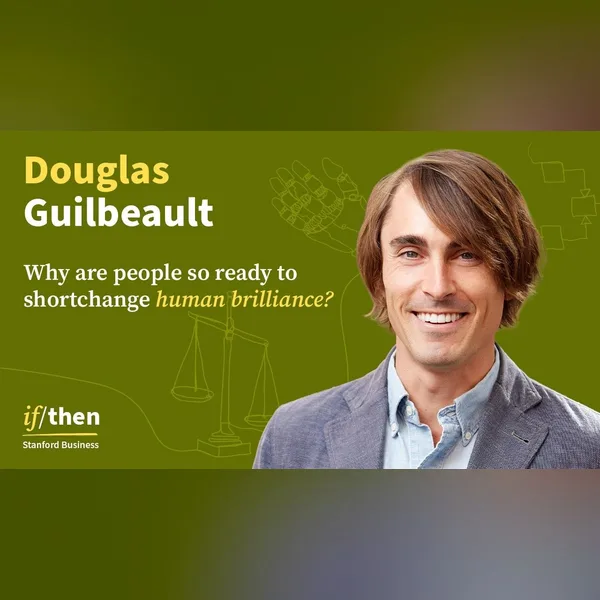
“Humans manage to do so much with surprisingly little,” says Douglas Guilbeault, an assistant professor of organizational behavior at Stanford Graduate School of Business. “Whereas AI, by comparison, is doing relatively little, but with so much power, so much compute, so many resources, and by comparison, relatively fewer constraints.”
On a bonus episode of the If/Then podcast, Guilbeault describes the implications of his recent work. Although he readily acknowledges that AI is “increasingly able to do quite a lot,” Guilbeault and his colleagues believe they have identified a key principle that distinguishes human intelligence from machine intelligence — and one which illuminates the limitations of machine thinking.
Although some researchers and AI boosters believe both humans and AI learn via optimization, Guilbeault and his colleagues have shown that another process more accurately captures how people distill the seemingly infinite complexity of the world and act based on limited information.
“You encounter a lot of noise, a lot of chaos, a lot of randomness,” Guilbeault says. “We somehow figure out how to make meaning and establish strong understandings from within that.”
What limitations have you encountered in your work with AI? Share your story with us at ifthenpod@stanford.edu.
Related Content:
Douglas Guilbeault faculty profile: https://www.gsb.stanford.edu/faculty-research/faculty/douglas-r-guilbeault
A Simple Threshold Captures the Social Learning of Conventions: https://www.gsb.stanford.edu/faculty-research/publications/simple-threshold-captures-social-learning-conventions
Find out more about If/Then: https://www.gsb.stanford.edu/business-podcasts/if-then
Listen on:
🔊 Apple Podcasts: https://podcasts.apple.com/us/podcast/if-then/id1725380194
🔊 Spotify: https://open.spotify.com/show/1v7V6LGUxfplMByTpVwk7h?si=38f353685fec4dd5
#gsbifthen #gsbpodcasts
Chapters:
00:00:00 Introduction
00:01:40 Why human learning matters for AI
00:05:03 Satisficing and the limits of optimization
00:06:41 Why LLMs learn differently from humans
00:09:58 The stakes of AI hype
00:13:11 “Humanity has had a good run”
00:15:19 Intuition, insight, & conceptual leaps
00:17:38 Beyond statistics: metaphor, vibes, & reasoning
00:19:39 A simple rule for social learning
00:21:18 Is there a ceiling for AI?
00:23:00 Randomness, disorder, & the path to insight
00:25:00 What an optimization mindset leaves out
00:27:54 Conclusion
28:52
“Humans manage to do so much with surprisingly little,” says Douglas Guilbeault, an assistant professor of organizational behavior at Stanford Graduate School of Business. “Whereas AI, by comparison, is doing relatively little, but with so much power, so much compute, so many resources, and by comparison, relatively fewer constraints.”
On a bonus episode of the If/Then podcast, Guilbeault describes the implications of his recent work. Although he readily acknowledges that AI is “increasingly able to do quite a lot,” Guilbeault and his colleagues believe they have identified a key principle that distinguishes human intelligence from machine intelligence — and one which illuminates the limitations of machine thinking.
Although some researchers and AI boosters believe both humans and AI learn via optimization, Guilbeault and his colleagues have shown that another process more accurately captures how people distill the seemingly infinite complexity of the world and act based on limited information.
“You encounter a lot of noise, a lot of chaos, a lot of randomness,” Guilbeault says. “We somehow figure out how to make meaning and establish strong understandings from within that.”
What limitations have you encountered in your work with AI? Share your story with us at ifthenpod@stanford.edu.
Related Content:
Douglas Guilbeault faculty profile: https://www.gsb.stanford.edu/faculty-research/faculty/douglas-r-guilbeault
A Simple Threshold Captures the Social Learning of Conventions: https://www.gsb.stanford.edu/faculty-research/publications/simple-threshold-captures-social-learning-conventions
Find out more about If/Then: https://www.gsb.stanford.edu/business-podcasts/if-then
Listen on:
🔊 Apple Podcasts: https://podcasts.apple.com/us/podcast/if-then/id1725380194
🔊 Spotify: https://open.spotify.com/show/1v7V6LGUxfplMByTpVwk7h?si=38f353685fec4dd5
#gsbifthen #gsbpodcasts
Chapters:
00:00:00 Introduction
00:01:40 Why human learning matters for AI
00:05:03 Satisficing and the limits of optimization
00:06:41 Why LLMs learn differently from humans
00:09:58 The stakes of AI hype
00:13:11 “Humanity has had a good run”
00:15:19 Intuition, insight, & conceptual leaps
00:17:38 Beyond statistics: metaphor, vibes, & reasoning
00:19:39 A simple rule for social learning
00:21:18 Is there a ceiling for AI?
00:23:00 Randomness, disorder, & the path to insight
00:25:00 What an optimization mindset leaves out
00:27:54 Conclusion